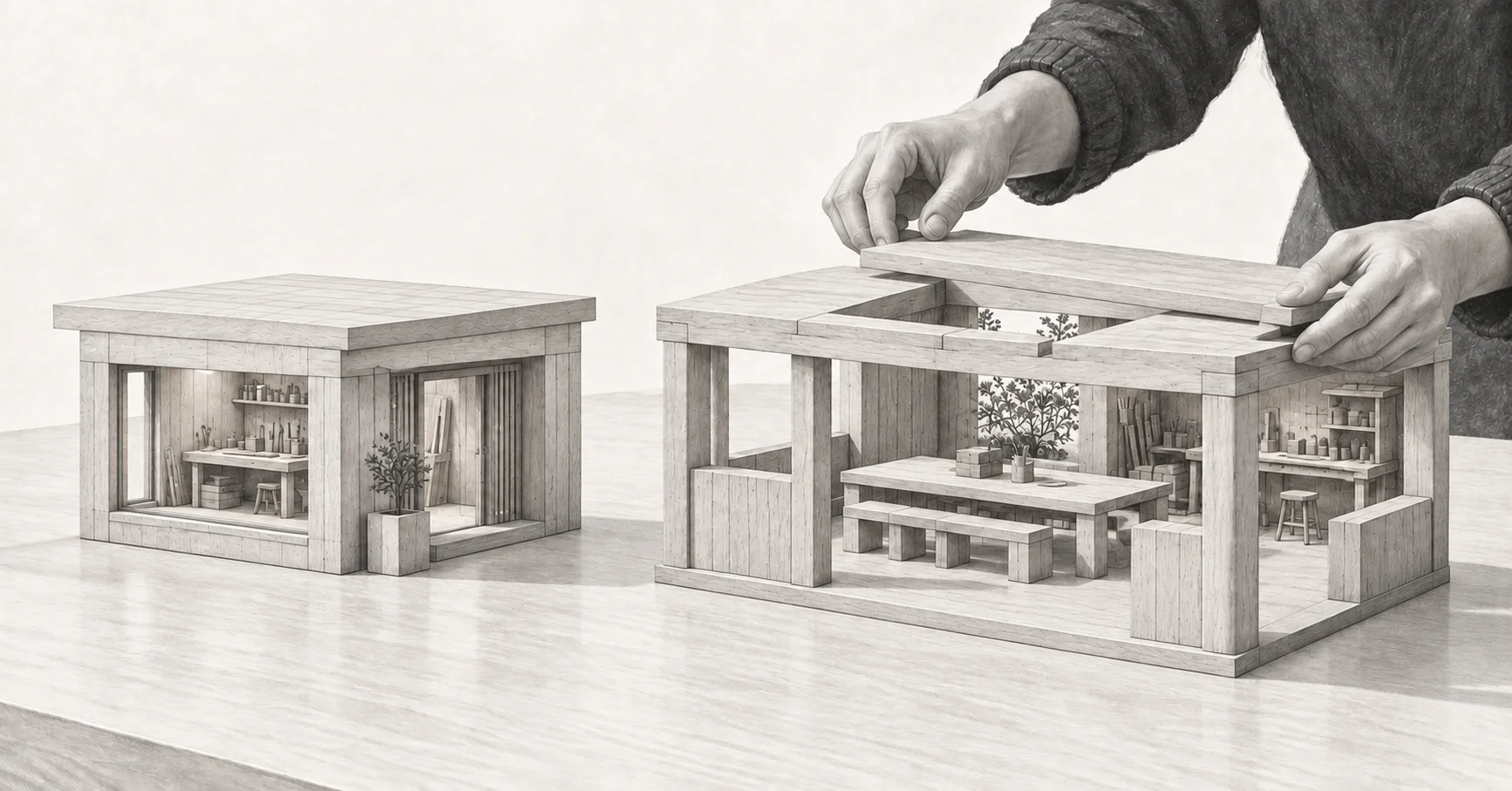
By the time a system works well, we may know enough to build it quite differently. We’re noticing this as AI helps us build software faster. The first version delivers real value. Building and using it also teaches us more about the work and the people doing it. What we learn can suggest a different way for the system to support them.
As we build, we decide where people should start, what they need to see and which steps they should follow. Each choice makes sense at the time. Once people use the whole system, we can see how those choices fit together and how well they support the work. We may begin to see possibilities we couldn’t have imagined at the start.
Take a historical example. At Xerox PARC, researchers built Aquanet to help people organize information by defining relationships between items. When they used it for real analysis, they noticed something else. People were expressing much of their understanding by moving items into piles and groups on screen. They could explore ideas this way before deciding exactly how the items were related. 1
These observations, along with lessons from other systems, helped shape VIKI. Its design put these spatial arrangements at the center of the work. 2 The Aquanet analysis took two years. With AI-assisted engineering, a similar cycle of building, using and rethinking a system may now take days.
What interests me is how something people found useful in the first system became the main idea behind the next one. A whole working system can be a prototype for discovering a different way of working.
Fred Brooks argued that, it is hard to know everything a complex software product needs to do until people have built and tried versions of it. 3 Douglas Engelbart looked beyond the software itself. He saw tools, methods, training and people as parts of a system that could improve together. Each improvement could help people make the next one. 4
By the next version, we understand more about the work. We also know more about what we can build. Faster development gives us room to act on that knowledge and try a different approach. The first system can keep serving people, while we explore what might work better.
The challenge is, it is easy to stop once a system works. It delivers value, and questioning its design takes effort. Small improvements are often easier to explain and plan than a different way of organizing the work.
We can start by asking: what could we do differently now that we have built and used this? With Aquanet, the researchers saw how much people could express through the placement of items. Our own systems may reveal something else: a decision that matters more than we thought, or a task that belongs at a different point in the process.
Slightly orthogonal to this is a research on parallel prototyping, gives us another reason to explore alternatives. In a study of advertisement design, one group developed several designs at the same time. Another worked through designs one after another. Both made the same number of prototypes. The first group produced more varied designs, and their final ads performed better. 5 This was a short design task, but it suggests there is value in trying more than one approach in succession.
We can give this exploration a clear purpose and a limit by testing one promising alternative against the working system. That means considering both the total effort involved and the quality of the thinking and decisions it makes possible. It may uncover new automation opportunities. What we learn may lead to a meaningfully better system in the end.
The first working system is already an achievement. It also gives us a better starting point for what comes next. When building becomes faster and cheaper, some of the time gained can go toward exploring arrangements we couldn’t have conceived when we started.
Marshall, C. C., & Rogers, R. A. (1992). Two Years before the Mist: Experiences with Aquanet
Marshall, C. C., & Shipman, F. M. III. (1995). Spatial Hypertext: Designing for Change
Brooks, F. P. (1986). No Silver Bullet — Essence and Accident in Software Engineering
Engelbart, D. C. (1962). Augmenting Human Intellect: A Conceptual Framework
Dow, S. P., et al. (2010). Parallel Prototyping Leads to Better Design Results, More Divergence, and Increased Self-Efficacy